

Saso was born in Slovenia, growing up on the outskirts of Ljubljana. Family holidays involved getting the car and driving across Europe, camping, to Croatia, or the Western Europe Mediterranean: Like most of Europe in the 80s, barriers were merely financial, before the Balkans war.
At the time the country was Yugoslavia, and while conflict erupted between various ethnic groups, Serbs, Croats, Bosniaks, Albanians and others, Slovenia was largely not involved, being the first of Yugoslavia’s six republics to formally leave in 1991. So the country, in name, that Saso grew up in was no more, with Slovenia declaring independence.
[After the Austro-Hungarian Empire’s demise and World War 1, it had united with Montenegro, Serbia, and Croatia in December 1918 to form a new nation called the Kingdom of the Serbs, Croats, and Slovenes, renamed to Yugoslavia in 1929. In 1946, it became a socialist federation of six republics: Croatia, Montenegro, Serbia, Slovenia, Bosnia and Herzegovina, and Macedonia and adopted the name Socialist Federal Republic of Yugoslavia (SFRY)].
Independence combined with collaboration was not new to these ethnic groups, and political borders just artificial social constructs.

At the University of Ljubljana Saso studied a Bachelor’s degree in Comparative Literature and Philosophy at the Faculty of Arts, and a Master’s degree in International Economics at the School of Economics and Business.
He didn’t set out to work in tourism. Rather, for 6 years he was the publisher of a children’s magazine, founded with his father at the turn of the millennium. Named “Hepko” in Slovenian, “Happy” in English after its main character, an alien from outerspace who just wants to make everyone happy, irrespective of religion, race or social status. The magazine sought to be published all over the world so children everywhere could see they were equal, with the same wishes and aspirations no matter their background – perhaps diametrically opposed to the Yugoslav wars that raged in the region through the 1990, to focus on the positives.
The magazine was published monthly in Slovenian and bi-monthly in English, and sold in all Slovenian elementary schools, peaking at several thousand copies sold a month. However, as sales dwindled, so Happy Tours school group excursions and trip organisation developed from 2000 onwards, demonstrating Saso’s entrepreneurial and travel-oriented nature. Extending to teachers’ trade union trips and beyond, it became the bigger business, resulting in the cessation of the magazine and focus on the tours.
Where the trips were initially for Slovenian outbound groups, during the 2008 global economic crisis, the company recognized the opportunity of shifting focus from organising trips abroad to realising the demand and income to Slovenia and neighbouring Balkans region countries like Croatia and Bosnia, by now well clear of conflict and with growing demand.
On a wider scale, being in Slovenia at the crossroads of major European regions, from East to West and Nordics to Mediterranean/Balkans at a post-war time of growth has enabled a bridging of cultural environments and to serve as an ideal starting point for organizing trips across Europe.
Consequently, the company now has offices in Slovenia, Croatia, Greece, London as well as sales operations in China, Malaysia and India!
With roots and continuation as a family business with his mother having done accounts and wife also working in the company, it’s clear that Saso values relationships, trust and dedication and a “Happy family” of staff.
But also a wider perspective, and so inclusive leadership, recognising where it’s better for specialists to take charge and responsibility, so creating one of the most important and fastest growing European tour operators.
Saso also believes in bridging gaps between different parts of the world, as evidenced by the company’s connecting East and West through tourism guests from Asia to Europe.
“Tourism enriches us, so I want to be associated with it. I want to do the things that interest me, make me happy, those which I believe have a positive impact on the environment. I am not committed solely to Slovenian society, because I believe that we are all equal” – Sašo Krumpak, Founder (EY.com, 2017)
Diversity and multicultural knowledge helps understand various markets and cultural specifics, not just essential for quality implementation of local tourism but also a competitive advantage: He employs around 150 skilled professionals from over 14 countries who speak ~16 languages collectively, priding themselves on high-quality customer service and fast response times, supporting ~2,000 groups / ~100,000 passengers annually.
This was obviously a challenge when the world’s tourism was locked down for the Covid-19 pandemic for multiple years from 2020, especially from Asia.

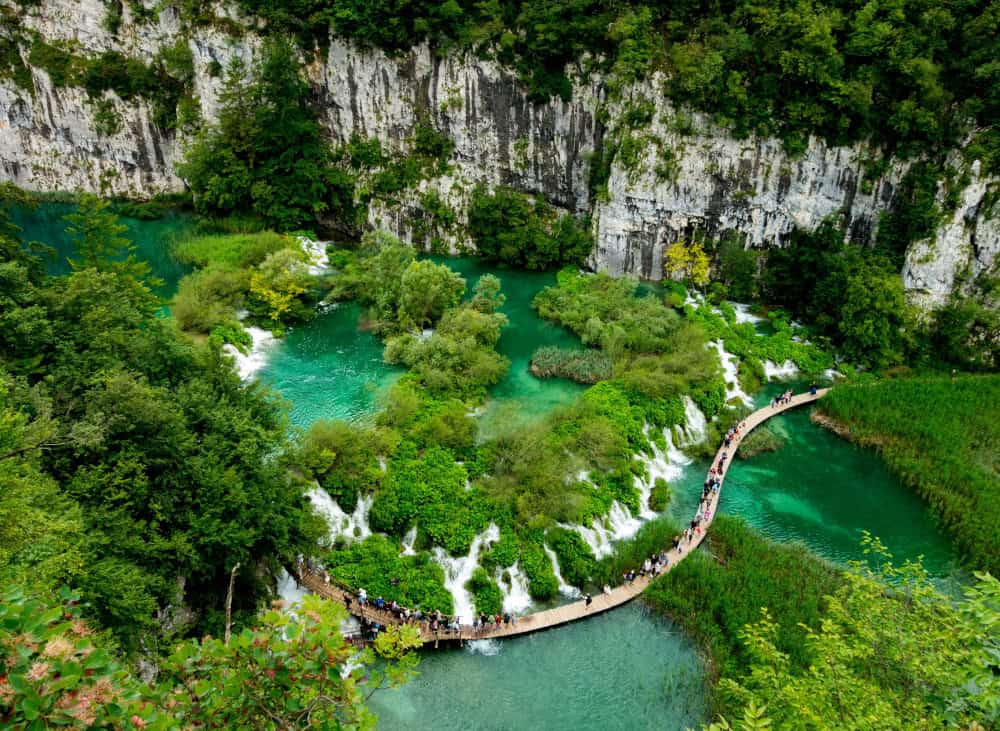
But as an entrepreneur, Saso’s dynamism and positivity sees opportunity in the contrary: they expanded into the hotel industry by buying the now-closed school land in an almost destroyed village in a beautiful part of the Balkans next to Plitvice National Park (Croatia’s most popular natural attraction) which lacked quality accommodation options, with the aim of regeneration.
But despite employing multi-ethnicity teams, employees can naturally gravitate towards their own cultural compatriots.
So with Saso placing great importance on cross-cultural collaboration, shared experiences and inclusive development, it’s no surprise that the new hotel is where he chose to bring together a now annual team gathering,
“It is very important that the teams get to know each other and that people who communicate via Skype and the phone meet each other in person and discuss the problems that might arise throughout the year. At the same time, this is an opportunity for leadership to outline new policies and technological changes. This gathering is very important for the company and employees as it gives them the opportunity to get a feel for work outside of their own department,” (EY.com, 7/11/17)
Annual gatherings of employees from all offices have helped in fostering understanding between teams, discussing problems, and outlining new working practices.
Saso started working in a region which had been torn apart by conflict between multiple ethnicities, the importance of travel for cross-cultural connection, and the common language of travel that shares joy clear in the personalised approach to the company’s vision to “Make all our travellers Happy”.

But beyond creating a great travel company, Saso is also only too well aware of the impacts that accompany that.
“For us sustainable travel is the key to safeguard both our planet, as well as to encourage positive practises of human co-operation and responsible development – and we want to play an active part towards this.” (Happy Tours Blog, February 2020)
2020 under lockdown he saw as a ‘trial’ year of carbon measurement and plan for offsetting and reduction with a plan to get to carbon net zero.
At the Hotel Lyra Plitvice, the mission is to act as a catalyst for change and reconciliation, regenerating the village economy and bringing together all the ethnic communities. Info & book >