


In Part 1, we asked How to Measure Tourism’s Impact and what’s wrong with targeting quantity of visitors, not quality?
Previous measures of tourism success, and thus how destinations are targeted, have been economic, based on quantitative volumes of tourism. But ‘success’ in this way merely creates overtourism, and many destinations are keen to change the way that tourism performs so it works for them, not vice versa.
And so enlightened destinations are working on different to measure, monitor and target tourism.
We talk about the Sustainable Development Goals significantly on this site: Each is detailed in the ‘Purpose’ section with organisation examples to show how tourism need not have just a positive impact on guests, but host communities too. With its 17 Global Goals, 169 targets and 232 unique indicators, the UN provides a great framework to destinations to help create tourism for sustainable development. But do we always need to develop, and what about how host communities feel?
Tourism Measured by Happiness
Bhutan is known for its “Gross National Happiness” (GNH), or Gross Domestic Happiness (GDH), philosophy that guides and is instituted as the goal of the government, in its Constitution since 2008 (although it originally came from the term coined by one of the founding fathers of the European Union in 1972).
GNH includes an index used to measure the collective happiness and well-being of the population, which the UN General Assembly urged other members to follow as an example.
International Day of Happiness
In 2011, the UN also passed the Resolution “Happiness: towards a holistic approach to development” calling happiness a “fundamental human goal”, and in 2012 joined with Bhutan’s Prime Minister for the “High Level Meeting: Well-being and Happiness: Defining a New Economic Paradigm” in which the first World Happiness Report was issued, to encourage the spread of Bhutan’s GNH philosophy. Shortly after, 20 March was declared to be International Day of Happiness by the UN.
Replacing GDP with GNH
GNH is also foundational and central to Planet Happiness’ (a global grass-roots project focused upon UNESCO World Heritage sites) interest in the wellbeing and the “beyond GDP” agenda: its co-founder and director an Observer of the Bhutan PM’s Jan 2013 International Expert Working Group meeting that sought to replace GDP with GNH as a measure of national and global development by 2015, and later became Chief Technical Advisor for Bhutan’s 2013-18 National Tourism Strategy & Development Plans (Nov 2011 – June 2012).

The Happiness Index
GNH is distinguishable from GDP by valuing collective happiness as the goal of governance, by emphasizing harmony with nature and traditional values as expressed in 4 pillars and 9 domains of Happiness.
The 4 Pillars of Gross National Happiness are:
1. Sustainable and equitable socio-economic development;
2. Environmental conservation;
3. Preservation and promotion of culture; and
4. Good governance.
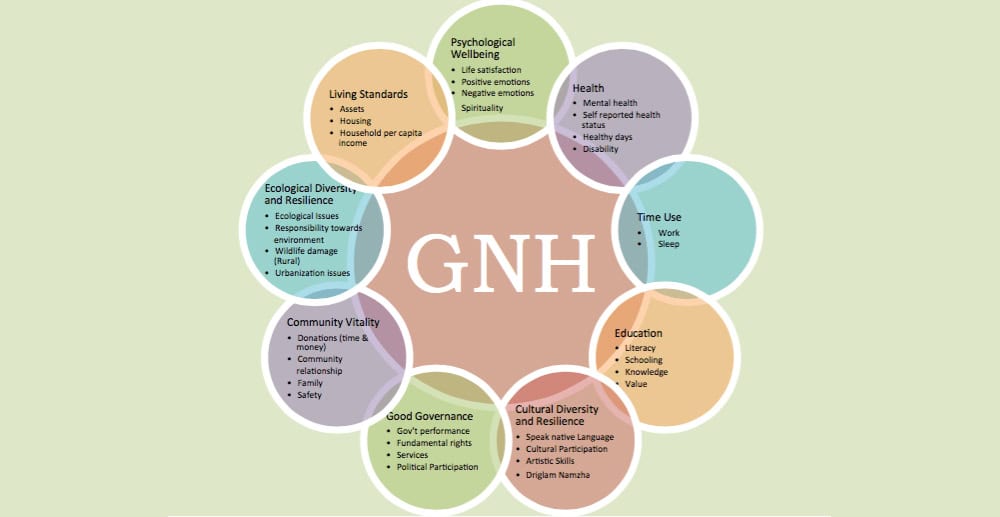
The 9 Domains of Gross National Happiness are:
• Community Vitality
• Cultural Resilience and Promotion
• Environment
• Education
• Good Governance
• Health
• Living Standards
• Psychological Wellbeing
• Time Use
In addition, Planet Happiness adds 2 further domains to its work now in global World Heritage sites (which enable a determined boundary to a study and discussion around the purposes of culture and protection).
• Satisfaction with Life
• Work
These surveys measure and monitor the happiness and collective well-being of destination communities’ residents over time (15mins to complete on-line, available in 21 languages and growing), producing result score-cards to identify, compare and contrast strengths and deficiencies of different community well-being.
As such Happiness scores and result cards are used as a bridge for dialogue between local communities, government & private sector – stakeholders who can discuss results, implications and solutions and work together to develop tourism responsibly by supporting actions to strengthen the collective well-being of host communities.
The domains clearly demonstrate that from the perspective of GNH, many inter-related factors are important in creating the conditions for happiness, such as time, nature and culture as well as material security.

The Bhutan GNH Index is considered to measure societal progress similarly to other models such as Gross National Well-Being, the OECD Better Life Index, and the Social Progress Index as used in Costa Rica.
One distinguishing feature of Bhutan GNH Index is that the other models are designed for secular governments and do not include religious behaviour measurement components.
However, critics say that the GNH was a propaganda tool to distract from previous governments’ ethnic cleansing of non-Buddhist and human rights abuses, and that most citizens live in poverty.
In accordance with its 9 domains, Bhutan has developed 38 sub-indexes, 72 indicators and 151 variables that are used to define, measure and analyse happiness of a people over time.
According to the World Happiness Report 2019, Bhutan was ranked 95th out of 156 countries.
Read more:
- In Part 1, we ask How to Measure Tourism’s Impact?
- In Part 3, we look at measuring the impact of tourism through well-being, social progress and living standards
- In Part 4, we consider Rethinking Tourism Development – Doughnut Economics
- Post Covid: A more sustainable ‘New Normal’?