

UN Sustainable Development Report
Red List Index
Global Gender Gap Rank
Climate Change Performance Index
Human Development Index
Population: 32 million
Capital: Antananarivo
Language: Malagasy / French
Currency: MGA: Malagasy Ariary
Tourism contribution to GDP: 13%
A Treasure Island
Madagascar is the Earth’s fourth largest island and a unique travel destination that promises wonder-ful adventure. It is among the world’s most significant biodiversity hotspots and an unforgettable experience whether you’re hiking through rainforests or relaxing on pristine beaches.
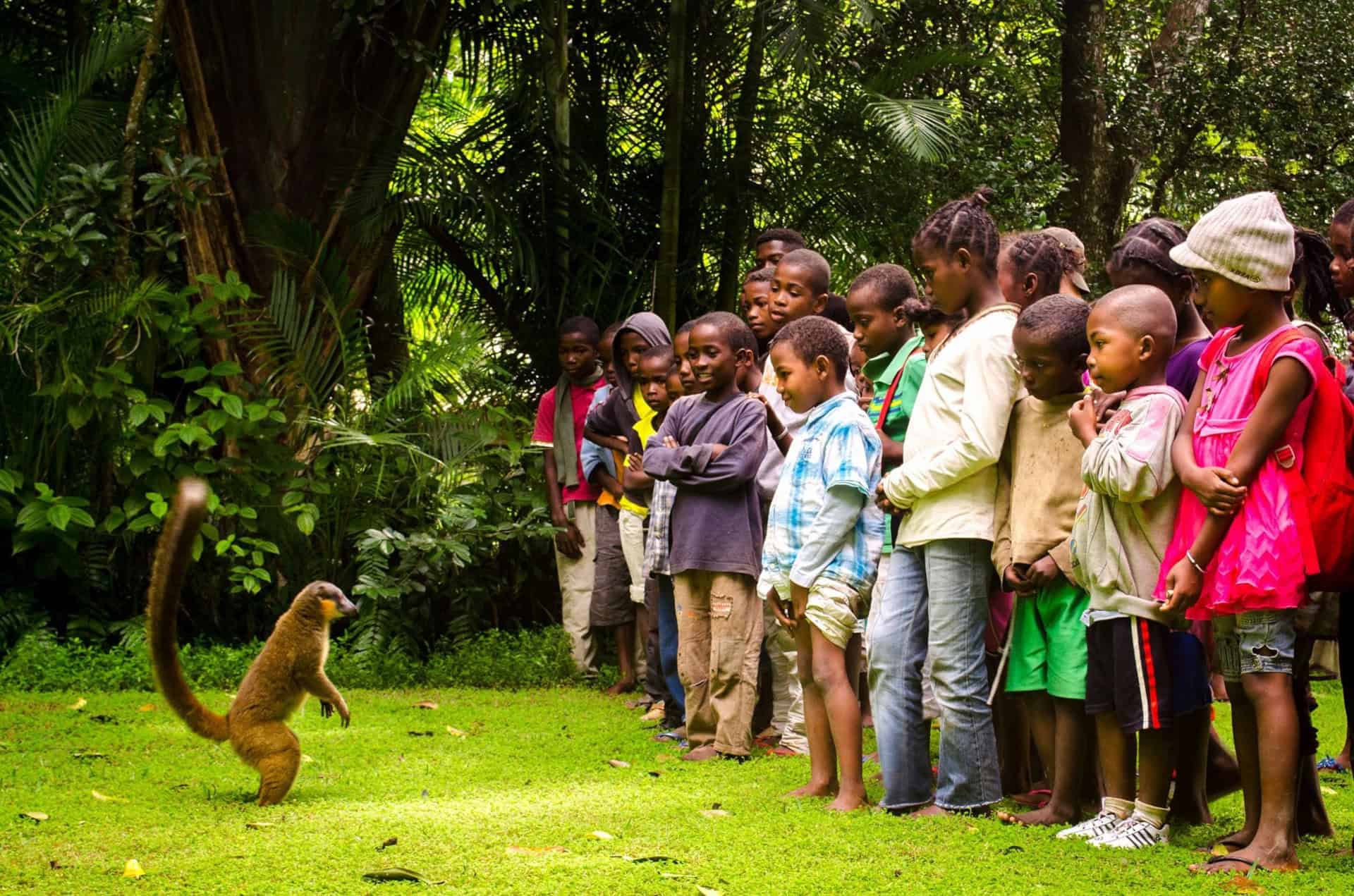
Geographically isolated for 80 million years, it is home to an astonishing diversity of plant and animal species: The general level of endemism among its flora and fauna is estimated at over 80%: 8 out of every 10 species found in Madagascar not found anywhere else on Earth, many species yet to be named or even discovered. This represents about 5% of Earth’s plant and animal species found within 0.4% of the planet’s land surface. The lemur is probably the best known Malagasy endemic species, with over 100 subspecies!
This biodiversity characterises this magical island as a unique travel destination, separated into sections of Northern, Eastern, Western and Southern Madagascar, its Central Highlands and Coastal areas.
Public transport can be limited, unreliable and overcrowded, and many roads are in poor condition, so a private driver with a 4×4 vehicle or organised tour is recommended for exploring.
“Madagascar is an unrepeatable experiment; a set of unique animals and plants evolving in isolation for over 60 million years. We are still trying to unravel its mysteries; how tragic it would be if we lost it before we even understood it” — David Attenborough, piece to camera, ‘Madagascar’, February 2011
Madagascar offers unique experiences in biodiversity, landscapes, and culture that attract nature enthusiasts, adventure seekers, and those interested in unique wildlife, particularly lemurs.
May to November: Dry Season: The ideal time to visit. Peak tourist season is June to September. The central highlands can get quite chilly.
November to April: Tropical cyclone Season – be cautious, particularly in February and March.
Madagascar Weather Variations
Madagascar Climate Change Trends
Madagascar is one of the top three countries considered vulnerable to the effects of climate change, which is increasingly evident: Madagascar has experienced a 10% rise in temperature and a 10% decrease in rainfall over the last 50 years.
The dry season is becoming longer, and the rainy season’s onset is delayed, particularly in the south, and usual seasonal cycles are increasingly subject to erratic change.
Temperature projections indicate an increase of 1.1–2.6°C by mid-century (2046–2065), depending on the region. The south is expected to warm the most, while the north and coastal areas will warm the least, threatening biodiversity, human livelihoods and socio-economic stability.
Changes in temperature and precipitation patterns are expected to reduce suitable habitats for many species, leading to declines in population and biodiversity.
Eastern rainforests face considerable habitat loss due to the combined impacts of climate change and deforestation.
Coral reefs are likely to suffer from increased bleaching events and damage from more intense cyclones, leading to declines in fish populations and increased coastal erosion.
Madagascar experiences an average of 3-4 cyclones per year, which are becoming more intense due to climate change, although they may become less frequent. This increases the risk of flooding and damage to infrastructure.
Southern Madagascar’s recent trends show a significant increase in drought conditions due to delayed rainy seasons and reduced soil moisture.
Changes in rainfall patterns and increased frequency of extreme weather events threaten agricultural productivity, impacting food security and livelihoods. Farmers in southern Madagascar, in particular, need to adapt to drier conditions.
Reduced and more variable precipitation affects water availability, posing challenges for both human consumption and agricultural use.
Climate change is expected to increase the prevalence of infectious diseases and exacerbate health issues related to malnutrition and water scarcity.
The drought in the south has led not only to food insecurity but driving the world’s first declared “climate change-induced famine” in southern Madagascar, also leading to rising mental health impacts among adolescents from repeated climate disasters and food insecurity.
Mitigation and Adaptation Efforts
Madagascar is a signatory to the Paris Agreement and has developed a National Policy to Combat Climate Change, focusing on strengthening adaptation measures and reducing vulnerability, including protecting and restoring forests, particularly in the south.
Efforts are being made to increase access to renewable energy sources, such as solar power, to reduce reliance on biomass and mitigate deforestation.
International development organisations are supporting Madagascar in creating and implementing climate adaptation and mitigation strategies, including the preparation of a National Adaptation Plan (NAP).
Madagascar’s ancestry is a blend of African, Asian, and Polynesian influences, home to 18 ethnic groups, each with unique customs and traditions.
Ancestor worship is very important, and many still consult soothsayers and healers, blending alongside traditional religions such as Christianity, the faith for ~50% of the population.
As such, there is a strong emphasis on respect for God, ancestors and elders and family, with hospitality and friendliness highly valued.
The concept of “fady” (taboos) plays a significant role in daily life and customs.
Rural areas remain highly traditional, with decisions often made by male elders, and family defined including extended relatives.
Traditions and Ceremonies play a strong role with traditional music and dance are a vital part. Male circumcision is an important rite of passage; and Famadihana (“turning of the bones”) commonly honours deceased relatives by rewrapping their bones.
Greetings and politeness are highly valued, with the use of “Azafady” (excuse me/please) common and appreciated.
The countryside remains more traditional in lifestyle and political structure, with urrban areas showing more Western influences in dress and entertainment: More young people are migrating from rural to urban due to limited economic opportunities, and the social and community structures impacts it brings.
Traditional arts include woodcarving and textile weaving, and in rural areas, ceremonies and traveling performers are main sources of entertainment, whereas urban areas have modern entertainment options.
This brings the challenge of balancing traditional cultural practices with modernisation, and abject poverty.
Madagascar’s environmental issues also impact heavily on the Malagasy people, who mostly work in subsistence agriculture; two thirds live in rural areas, with limited education or secure food sources.
Inadequate diets lead to 50% of children under 3 malnourished and suffering retarded growth, with 10% dying (40% in rural areas) before the age of 5 from easily preventable diseases, such as diarrhoea. Poor hygiene also leads to typhoid, polio, acute respiratory infections and trachoma blindness. Just 35% have improved water sources, and just 11% adequate sanitation facilities.
Poor health was recognised by the Malagasy government as one of the key challenges to Madagascar’s future development in the Madagascar Action Plan of 2007-2012, a national strategy developed in response to the Millennium Development Goals, but the situation became notably worse during this period.
Since 2009, political crisis also saw government spending on public services cut 40%, on health cut by 75%, on education cut by 82%, the price of basic food staples like rice double, the value of saleable assets like cattle halved, jobs lost and the trade in endangered species accelerate.
Sadly, such increases in poverty and environmental damage occurred at the same time as major cuts in international donor support, which previously formed half of the total national budget.
As such, Madagascar is one of the world’s least developed countries, and most impoverished, ranking near the bottom of UN Human Development Index.
“At only $22 per day, the Malagasy national health system is amongst the worst funded in the world” — World Health Organisation, 2014
Whilst government spending on health and donor support have expanded slightly, particularly in the wake of Covid-19, Madagascar still ranks near the bottom globally for health system funding (WHO).
68.4% of people in live in multidimensional poverty (UNDP, 2023), with 92% of the 22 million inhabitants below the poverty line of $2 per day (World Food Programme).
Throughout Madagascar, especially in rural Anosy, women are prevented from accessing paid work due to domestic responsibilities, cultural expectations, and a lack of earning opportunities. As a result, women often suffer the most from the effects of extreme poverty.
As a result, in rural fishing communities, employment and sole family income is largely dependent on the male-dominated, increasingly-unpredictable, fishing industry, leaving single and widowed women vulnerable and even families insecure.
With global warming, as fishing opportunities are becoming less reliable and increasingly dangerous, there is a clear need to diversify earning opportunities, yet the majority of locals do not complete primary education and have extremely low levels of literacy.
Madagascar has developed distinct ecosystems and extraordinary unique wildlife due to its long isolation from other landmasses. The island harbours lush rainforests, tropical dry forests, plateaus, and deserts.
Approximately 95% of Madagascar’s reptiles, 89% of its plant life, and 92% of its mammals are endemic: they exist nowhere else on Earth.
The best known Madagascar endemic species is probably the lemur, with over 100 subspecies under different degrees of threat through loss of habitat, hunting for bushmeat and capture for the pet trade, but 98% are threatened with extinction. Some may even go extinct prior to even being identified. Six lemurs are listed among the “Top 25 Most Endangered Primates”.
Of around 12,000 flowering plant species, some 10,000 are thought to be found nowhere else on earth. Six of the planet’s nine baobab species are native to Madagascar, a seventh being found both on the island and in mainland Africa.
Despite being one of Earth’s top biodiversity hotspots, Madagascar has so far lost an estimated 90% of its original forest vegetation. Limited livelihood options for the Malagasy people often means traditional ‘slash-and-burn’ subsistence, along with fishing, for land for agriculture and wood for fuel and timber.
Protected areas, although important for conservation, have been imposed with little or no community consultation, and negatively impact local people by restricting access to vital livelihood resources, imposing fines, creating more pressure on unprotected areas and not addressing the root cause: forest-dependent communities lack access to alternative resources.
Deforestation, erosion and soil degradation, aggravated by bushfires, culturally-significant but environmentally-destructive slash-and-burn clearing techniques, and the use of firewood as the primary source of fuel and small scale but widespread production of charcoal, are serious concerns to the agriculture dependent economy. Over 1 million hectares of rainforest were lost between 2002–2023.
Added to that, resource extraction operations of Madagascar’s rich minerals, often dominated by foreign interests, add pressure to deforestation and natural environment and habitat loss, with the remaining forest more and more threatened, fragmented, and unable to sustain life.
Plus, overexploitation of living resources, including hunting for food (eg. lemur) or over-collection of species for international trade (reptiles and amphibians) despite legal protections, plus poorly regulated fishing with foreign boats encroaching on local areas, and introduction of alien species, create further damage for Madagascar’s environment.
And in the marine environment, coral bleaching is intensifying due to climate change’s rising sea temperatures, affecting the marine ecosystem and coastal livelihoods.
With 80% population living below the poverty line and dependent on subsistence farming, pressure is put on natural resources and environmental degradation impacted: The government is focusing on restoring forests, supporting reforestation programs, and working with NGOs on both biodiversity and community resilience initiatives (World Bank).
“Madagascar is a mostly unregulated economy with many untapped natural resources, but no capital markets, a weak judicial system, poorly enforced contracts, and rampant government corruption.” (Economy.com)
Madagascar’s economy is characterised by a mixture of traditional agricultural practices and emerging sectors such as extractive industries, tourism, and telecommunications. (Economy, BBC)
Agriculture including fishing and forestry, accounts for more than 25% of GDP and employs roughly 80% of the population. Key agricultural products include paddy rice, coffee, vanilla, and cloves. Madagascar produces around 80% of the world’s vanilla and its reliance on this commodity for most of its foreign exchange is an additional significant source of vulnerability.
Mining has seen significant growth, particularly in the extraction of minerals like nickel, cobalt, and graphite, crucial for the global energy transition. (African Development Bank Group).
The national poverty rate remains high, at 75.2% in 2022. Poverty is especially high in the south and the southeast, where it exceeds 91.2%, due to climate shocks (droughts, cyclones, and floods).
Tourism is seen as an important economic development strategy by the Madagascar government, aiming to reduce poverty and provide economic growth.
As of the mid-1990s, tourism was the country’s second largest export earner, bringing in US$50+ million annually.
The tourism industry has been growing in Madagascar, but it is still considered underdeveloped compared to neighbouring island nations like Seychelles and Mauritius, with challenges in infrastructure and accessibility.
The sector has also faced challenges due to political crises, particularly in 2001-2002 and 2009, and 70% decline in 2020-2022 due to Covid-19 international travel lockdown, which negatively impacted tourist arrivals and the industry’s contribution to GDP, with strong recovery since 2024.
The government is targeting over 400,000 international tourist arrivals by the end of 2025 with ambitions for 1 million by 2028.
Conservation in Madagascar
Attempts to conserve Madagascar’s forests were introduced by rulers in the establishment of environmental regulations, the earliest being seen in 1881 when Queen Ranavalona II placed a ban on using slash-and-burn techniques in agriculture.
When Madagascar came under French colonial rule in 1896, the government brought concepts of scientific forestry and rational economic exploitation to the island.
Several agricultural research stations were established, including the Jardin of Ivoloina in 1897, to experiment with improving existing agriculture and testing the viability of exotic plants and crops.
During the colonial period, the 1910s-1940s saw early conservation efforts.
Concerns about forest loss led to the creation of “nature reserves” and later “special reserves” and “national parks”.
Early scientific interest in Madagascar’s unique biodiversity was driven by European expeditions, which laid the groundwork for later conservation efforts.
The colonial government continued to establish national parks and reserves to protect Madagascar’s unique flora and fauna, and to implement scientific forestry practices to manage forests for wood production and soil protection.
However, these efforts were often hampered by a lack of human and financial resources which led to poor management, underfunded: the state lacked sufficient resources to effectively enforce conservation measures and contain deforestation by commercial exploiters.
Thus from the 1940s to 1960, significant deforestation continued due to commercial exploitation and traditional agricultural practices like slash-and-burn (‘tavy’) to clear new land for farming.
Conservation efforts often excluded local Malagasy communities, who were traditionally dependent on forest resources for their livelihoods. This exclusion sometimes led to conflicts and resistance to conservation policies.
However, this all laid the foundation for modern conservation initiatives in Madagascar to highlight the island’s unique biodiversity and the need for its protection, setting the stage for post-independence policies.
After independence in 1960, conservation efforts faced challenges due to association with colonialism. Government agencies thus began managing conservation using a top-down approach, and Non-Governmental Organisations also became involved.
In the 1980s, the Madagascar government recognised environmental degradation as a major threat. The National Environmental Action Plan was developed with help from international donors and NGOs. This plan aimed to address environmental destruction, reduce poverty, and protect biodiversity in parks and reserves.
The first phase of the National Environmental Action Plan (1991-1995) emphasised an “integrated conservation and development” approach, aiming to involve local communities in conservation efforts and ensure they benefitted from protected areas.
More recently, there’s continued focus on balancing conservation with local livelihoods and development needs, and an expansion of protected areas, with 21.3% of land area now protected.
There is increased attention to marine conservation, with 22 formal Marine Protected Areas (MPAs) covering about 1.26% of Madagascar’s Exclusive Economic Zone, around 200 Locally Managed Marine Areas (LMMAs), which are either officially designated or managed through local community bylaws, bringing the total marine area under formal protection to ~14,451 km²: 1.3% of Madagascar’s territorial waters (World Bank).
There growing recognition of the role and importance of traditional practices in conservation, such as the forest gardens of indigenous peoples.
Deforestation remains a significant threat, with only 10% of Madagascar’s original forests remaining, whilst poverty and population growth continue to put pressure on natural resources.
Throughout history in Madagascar, there has been a consistent tension between strict conservation approaches and the need to integrate with development and local livelihoods. The involvement of international actors, both in funding and setting agendas, has been a constant feature.
Madagascar is now recognised for its potential in ecotourism thanks to its unique biodiversity, diverse landscapes, other natural resources and heritage and its conservation efforts
Its very challenge of climate crisis impact, biodiversity on land and marine, poverty, clean water need, food security, and employment creates an understandable emphasis for sustainable tourism aligned with UN Sustainable Development Goals and providing economic benefits to local communities: both incredible opportunity and significant challenge for truly sustainable and regenerative tourism.
Travellers who seek authentic, nature-driven experiences are encourages to take longer, immersive stays to maximise their experiences for the return on their travel carbon!
Historically, Madagascar’s focus on energy was largely on traditional biomass and fossil fuels: firewood and charcoal account for over 85% of household energy consumption, meaning significant deforestation and environmental degradation.
In 2021, investment in clean energy was around $32.68 million, a 72.56% increase from 2020.
The largest electricity-generating technology in Madagascar in 2022 was oil and diesel, generating 43.49% of electricity, though this is down from 52.38% in 2021.
Solar PV saw significant growth, with its share in electricity generation increasing from 4.68% in 2021 to 18.06% in 2022.
The Malagasy government has implemented policies to promote renewable energy, including renewable energy targets, feed-in tariffs, and net metering.
Madagascar has potential for hydroelectric and wind power and significant solar, with 2,800 hours of annual sunshine in almost all regions.
However, as of 2024, only 36% of the population has access to an electricity grid, and less than 12% use clean cooking technologies.
The government in collaboration with international organisations is working to close these gaps through initiatives like:
Integrated Energy Access Plan (IEP): uses advanced geospatial modelling to analyse electrification, clean cooking, and cold chains for medical and agricultural purposes. This helps identify optimal energy solutions based on cost, accessibility, and other factors.
Sustainable Energy Day: In 2024 this aimed to attract investments and raise awareness about the government’s energy access ambitions. It showcased achievements and launched the IEP to support the government’s goal of bridging the energy access gap.
The government aims to improve energy efficiency by 60% by 2030 through measures in households, businesses, and public infrastructures.
Despite progress, Madagascar faces significant challenges, including high costs of renewable energy equipment and logistics, limited infrastructure, a high reliance on traditional biomass and fluctuation in oil prices.
International support and investment, along with strategic planning and policy implementation, are critical to achieving energy access and sustainability goals.
Madagascar has unique biodiversity and conservation, however is challenged by poverty and resources. By working in partnership, Madagascar has achieved successes such as
Madagascar increasingly looks to sustainable tourism to be able to leverage its unique biodiversity and engage communities to deliver results aligned with UN Sustainable Development Goals, creating jobs and providing alternative income sources.