



Most lions are in Africa, with a small population of Asiatic lions in India. But since the commercialization of livestock ranching and agriculture in Africa, lions have undergone catastrophic declines.
An assessment of approximately three lion generations, 1993-2014, found a “population reduction of approximately 43% is estimated over the past 21 years” (Bauer et al; IUCN, 2015), estimating 23,000-39,000 lions remaining in the wild: less than 10% of the number of elephants that remain, and decreasing.
- IUCN (2023) put ~670 lions in India (now increased) and the current population of adult and subadult Lions in Africa between 22,000 and 25,000, their extant range only 6% of historical range.
- WildCru estimates a remaining population of 24,000 declining fast, nearly halving in just the past two decades, with around half the surviving lion populations with less than 50 animals.
- LionAid paints a bleaker picture, estimating a total of 13,014 lions in eastern and southern Africa and 342 in western and central Africa where resident lions are highly genetically distinct, and only five places in the world with at least 1,000 lions.
Lions are on the brink of extinction in all but the largest and best-managed protected areas. Outside of these places, lions are in grave trouble.
The Lion on the IUCN Red List
The IUCN Red List (of Threatened Species), established in 1964, offers a comprehensive overview of global conservation status, covering plants, animals, and habitats; The lion’s decline, more severe compared to other large carnivores, have led to its consistent Vulnerable listings in IUCN assessments since 1996.
Lions are resident in Angola; Benin; Botswana (~3,000); Burkina Faso; Cameroon; Central African Republic; Chad; The Democratic Republic of the Congo; Ethiopia; India; Kenya (~2,500) Malawi; Mozambique; Namibia; Niger; Nigeria; Senegal; South Africa (~3,300); Sudan; Tanzania (by far the most, ~8000~14,500 lions); Uganda; Zambia (~2350); and Zimbabwe.
They are probably extinct in Côte d’Ivoire; Eswatini; Ghana; Guinea; Guinea-Bissau; Mali; Rwanda; Somalia; South Sudan; and Togo.
Whilst listed as ‘Vulnerable’ on the IUCN Red List as a whole, across most of this range the lion is actually ‘Endangered’, and critically endangered in regional sub-populations in West Africa.
Populations have declined in West, Central and East Africa, though were bolstered by 12% increases in four southern African countries 1993 – 2014, including Zimbabwe, but especially Botswana, Namibia, and South Africa where populations are stable or increasing in protected and intensively managed areas. In South Africa, lions are of ‘Least Concern’. Human defence, urban development, agriculture, hunting and trapping, pollution and civil unrest threaten the species.
Lions have already gone extinct in Afghanistan; Algeria; Burundi; Congo; Djibouti; Egypt; Eritrea; Gabon; Gambia; Iran; Iraq; Israel; Jordan; Kuwait; Lebanon; Lesotho; Libya; Mauritania; Morocco; Pakistan; Saudi Arabia; Sierra Leone; Syrian Arab Republic; Tunisia; Turkey and Western Sahara.
If conservation measures are not successful at reversing current trends in the near future, the lion is highly likely to become Endangered as a whole.
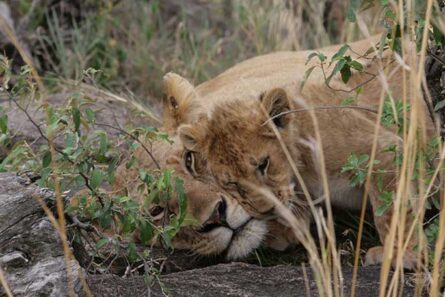
The Lion: Now
Officially ‘Vulnerable’ internationally, but generally more ‘Endangered’ regionally, the plight of lions is far from secure.
Although adult lions have no natural predators, most die violently from attacks by humans or other lions. Indiscriminate pre-emptive or retaliatory killing may occur to protect human life and livestock. Habitat loss and conversion has also led to a number of subpopulations becoming small and isolated (Bauer et al. 2008), and collapse in lion prey populations due to the bushmeat trade. Two other threats are trade‐related: trophy hunting and the lion bone and parts trade.
Lions: Traditions and protection
The Maasai traditionally viewed the killing of lions as a rite of passage, historically hunting as individuals. However elders now discourage solo lion hunts.
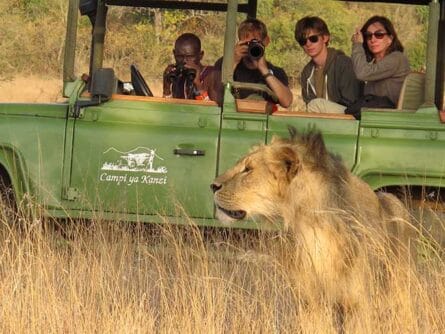
As pastoralists, they have also been fiercely protective of their cattle in the past. Now tourism is helping them see that lions, which bring tourism and support, are worth more alive.
Much work has been achieved to change this traditional behaviour, such as undertaken by our partner in Kenya with their ‘wildlife pays’ scheme – incentivising Maasai for good behaviour by compensating for any loss in livestock from an “ecosystem services” daily conservation fee paid by tourists, instead of facing loss of lion.
Lion Hunting for Conservation?!?
Trophy hunting of lions has been met with increasing controversy and the killing of Cecil the lion in mid-2015 by an American tourist created a significant international backlash against the hunter and the practice, both legal and illegal, although the hunting sector is also adamant on its ‘conservation’ value.
Whilst originally researching for this blog, we were shocked to discover last-chance limited-time marketing on lions; “Trophy Lion Hunting Safari, South Africa – Starting at only $12,000! Get your TROPHY LION while you still can!”. Even more shocking, updating in 2021 offers were discounted to $8750 – exportable, or $7500 for country residents, and in 2025 – $3500! Thankfully, a few countries – Australia, Belgium, France, the Netherlands – will not allow any imports. Finland restricts, Germany has plans and in Italy it’s proposed.
There are those that argue that hunting supports conservation of a species and it has had a net positive impact in a some areas. But not only is that counter-intuitive, because conservation is defined as preserving, guarding and protecting, it’s also not true: Non-consumptive year-round tourism and not limited season consumptive hunting brings much better long term investment and returns in income and species conservation than hunting, plus hunting takes up a disproportionate space and does not support local communities like tourism. Hunting has contributed to population declines in Namibia, Tanzania, Zimbabwe, Cameroon Zambia (IUCN, 2015) and Botswana – and one of the reasons it was stopped there, although many of those countries still host regulated hunting.
A lion is worth so much more alive, not least economically if shot on an ongoing basis by safari photographers rather than once in a hunt, and let alone environmentally to its immediate ecosystem or that of the planet.
Lion Poaching
Poaching is of course another challenge, rising due to demand for lion bone and parts such as teeth and claws to trade for traditional medicine mainly to Asia. This involves a currently legal component, involving mainly “canned hunting” farmed South African lions, and an illegal component – a developing threat to wild populations.
The increase may even be due to CITES efforts to curtail the farming of tigers for their bones in Asia but could equally further threaten tigers through perpetuating demand and continuing to stimulate poaching.
Lion Species
There are two species of Lion, full name Panthera leo, a carnivorous mammal ‘Felid’ – in the cat family, Felidae.
Between 2008 and 2016, IUCN Red List assessors used two subspecific names for lions: Panthera leo leo for African lion populations and Panthera leo persica for the Asiatic lion population. The latter is only found in the Gir Forest National Park and surrounding areas in Gujarat State, India, where the lion population has risen from ~180 lions in 1974, to ~650 in 2017, 674 in 2020, and 891 lions in 2025.
In 2017, the lion taxonomy was revised to consider historic geographic distributions and thus now recognises these two subspecies:
Panthera leo melanochaita
This subspecies, referred to as the ‘southern subspecies, includes the extinct Cape lion and lion populations in East and Southern African regions.
Panthera leo leo
This subspecies, referred to as the ‘Northern lion’ and ‘northern subspecies’, includes the Asiatic lion, the regionally extinct Barbary lion, and lion populations in West and northern parts of Central Africa.
Male lions (150-250 kg /330-550lb / 23.5-39 stone) are typically larger than females (120-182 kg /265-400 lbs / 19-28.5 stone), with a prominent mane, their most recognisable feature.
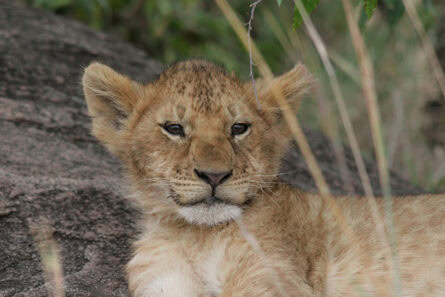
As cubs, they have spotted fur, which changes to uniform colour during development.
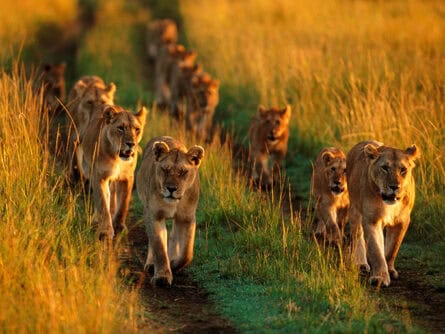
Lions are social, forming groups and living together in prides. An African lion pride consists of up to 4 adult males, related females and cubs. (Asiatic lion prides differ in group composition.)
Male cubs are excluded from their maternal pride when they reach maturity at around three years of age and enter a nomadic phase in search of their own territory before gaining residence in a pride. Some nomads range widely and move around sporadically, either alone, in pairs if related and excluded from their birth pride, or they may go on to form a ‘coalition’ with other males.
Females form the stable social unit in a pride and do not tolerate outside females, with membership only changing with the births and deaths of lionesses. Some females leave and become nomadic, though they stay closer to their natal pride than the males.
Lions: Designed for Hunting
As an apex (alpha) predator, lions are at the top of the food chain, although they scavenge when opportunities occur. But they are also a keystone species, which means they play a unique and crucial role in the way their ecosystem functions: Relative to their abundance, they have a disproportionately large impact on their natural environment. Without them, the ecosystem would dramatically change or cease to exist altogether. They make it possible for a myriad of plant and animal species to live in their environments as well. The loss of lions gravely affects many species that depend on the lion-ecosystems and causes major habitat chaos and a weakening to the structure and diversity of nature itself. This means that lion conservation is also ecosystem conservation.
Groups of female lions typically hunt together, with coordinated hunting allowing for more successful predation and may be the reason for their sociality, or indeed the maternal support in their sharing of raising cubs. When hunting, lionesses have specific roles. Some play the role of ‘centre’ and others the ‘wing’ chasing the prey towards the centre.
Lions prey mostly on large ungulates – hoofed species – preferring wildebeest, zebra, buffalo, gemsbok and giraffe to small hyrax, hare and monkey or fully grown adult elephants, rhinoceroses and hippopotamus.
Lions gorge themselves and eat up to 30 kg (66 lb) in one session; if unable to consume all of a kill, lions will rest for a few hours before continuing to eat, on hot days, with the pride retreating to shade and one or two males standing guard against scavengers such as vultures and hyenas.
Although they can be active at any time, their activity generally peaks after dusk with a period of socialising, grooming and defecating. Intermittent bursts of activity continue until dawn, when hunting most often takes place. They spend an average of two hours a day walking, 50 minutes eating and about 20 hours inactive.
Typically, the lion inhabits grasslands and savannas but is absent in dense forests. Habitat loss and conflicts with humans mean lion populations are untenable outside designated protected areas.
Both males and females defend the pride against intruders, but the male lion is better-suited for this purpose due to its stockier, more powerful build.
All felids are ‘digitigrade’ – they walk on toes and do not touch the ground with heels. They have five toes on their forefeet and four on their hind feet, with curved claws that protract by contracting muscles in the toe, and passively retracted.
To help them navigate (especially in the dark) and hunt, they have:
– Well developed and highly sensitive whiskers above the eyes, on the cheeks, on the muzzle, but not below the chin, which help to navigate in the dark and to capture and hold prey.
– Relatively large eyes, situated to provide binocular vision, and their especially good night vision (six times more light sensitive than those of humans) highlighted by a distinctive shine as light reflects back inside the eyeball. Unsurprisingly many species are at least partially nocturnal.
– They also hunt more during storms! The noise and wind make it harder for prey to see and hear them.
– Their large external ears, especially sensitive to high-frequency sounds in smaller cat species, to locate rodents.
– Tongues covered with rough ‘papillae’, which rasp meat from prey and aid grooming.
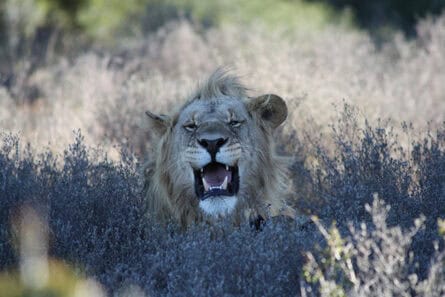
– Male lions grow impressive manes up to 16cm long and a sign of dominance. The older they get, the darker their manes. As well as attracting females, their manes may also protect their neck and head from injuries during fights.
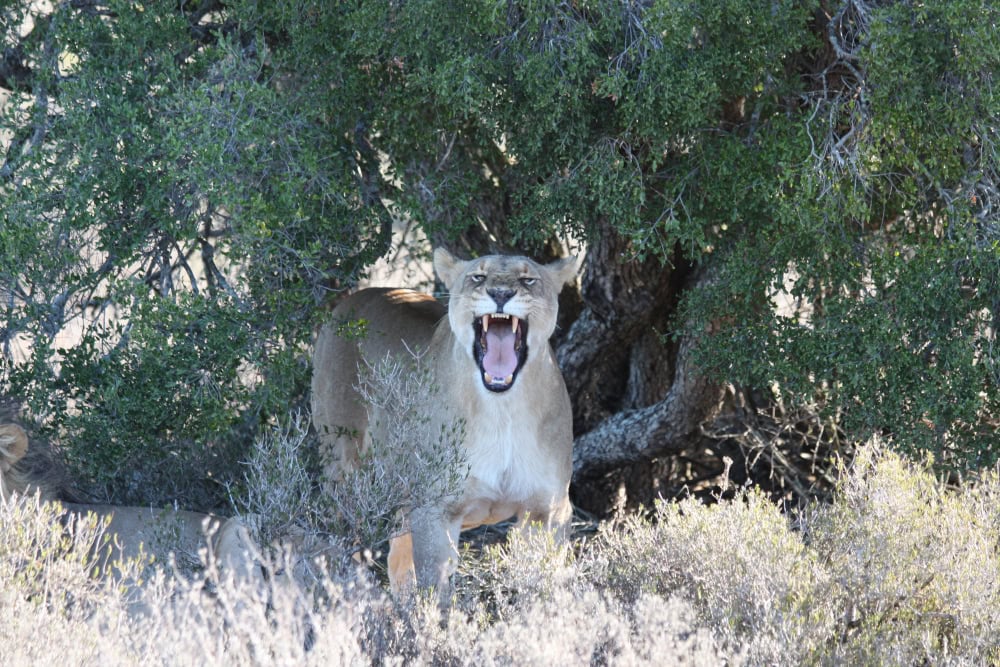
Cats meow as the main contact sound, but also spit, hiss, snarl and growl when defensive and aggressive, and purr, though some only during oestrus and copulation, and as cubs when suckling.
The lion’s closest relatives are the other species of the genus Panthera; the tiger, snow leopard, jaguar, and leopard. In fact, studies published in 2006 and 2009 indicate that the jaguar and the lion belong to one sister group that diverged about 2.06 million years ago; and studies published in 2010 and 2011 indicate that the leopard and the lion belong to the same sister group, which diverged between 1.95 and 3.10 million years ago.
Disney’s Lion King 2019
The 2019 Lion King digital animation version produced in Virtual Reality conditions didn’t just offer “the spectacle of a BBC wildlife documentary” but enabled Disney’s ‘protect the pride’ global conservation campaign to raise awareness of the crisis facing lions in the wild.
To coincide with the film, Disney launched limited special edition ‘Simba’ and ‘Nala’ plush toys. Each sale represents one of the 40,000 lions for which Disney and the Lion Recovery Fund, a joint effort by The Wildlife Conservation Network and the Leonardo di Caprio Foundation, worked to ensure a future.
Animals had been a part of Disney storytelling for more than 60 years, so the Disney Conservation Fund (DCF) was established on Earth Day 1995, inspired by Walt Disney’s conservation legacy, to help protect wildlife and wild places around the world. Since awarding more than $132million in grants, they have supported over 600 nonprofit organisations across about half the countries in the world and all 5 oceans and helped protect more than 1,000 species, to save wildlife, protect the planet and inspire action through nature experiences. In 2025, the Fund celebrated its 30th anniversary by awarding over $500,000 in new grants to support youth engagement and community-based global conservation projects.
Let’s hope it reverses the current trend and helps the real Lion king.
Take Action: Lion Support
-
Raise Awareness: At a click of a mouse, like and share this article.
-
Learn: For more information about ‘canned hunting’ of lions, see Blood Lions.
-
Experience: Seeing is believing: See and support lions in the wild in particular with our Earth Changers in Kenya. Or, ever considered a safari in Malawi?