


At Earth Changers, we don’t believe that ‘nofly’ campaigns or flight shaming (others) help, focused as they are on negatives that can alienate some people into complete lack of action. Plus, there are much wider considerations on balance beyond just flight carbon emissions. So we much prefer an open, honest discussion of truth: Destinations in need need positive impact tourism.
There is no getting away from the fact tourism is both affected fundamentally by climate change and a significant contributor to the global emissions of greenhouse gases (GHGs), and needs to carefully consider its balance of economic, social and environmental impacts with mitigation actions.
Previous research suggested tourism contributed 5-6% of total global greenhouse gas emissions; three quarters (4% total) from transport, including 40% (2.5% total) from aviation).
Other estimates for the portion of aviation emissions from man-made client change include 3.5% from the IPCC; 3% within Europe and 2% globally from the EU; and 2% from the International Air Transport Association (IATA). But for the UK, as an island and developed country, Gatwick Airport estimated that aviation accounts for 7.3% (2021).
It’s also anticipated that aviation’s percentage of greenhouse gas emissions will only increase: Where other industries can achieve significant cuts, while there is no immediate solution to alternative fuel, its share as a proportion of the remaining emissions will rise, at a time when flight demand is increasing.
In 2016, emissions in Europe’s aviation sector rose by 8% to 61.6 million tonnes of CO₂e; tripling by 2024 to nearly reach pre-pandemic 2019 level of 187.6 million tonnes of CO₂. Where as by 2024, emissions from other carbon-intensive sectors had been cut by about 50% compared to 2005, with a 5% year-over-year drop in 2024 alone.
Now, it’s reported that global tourism accounts for 8-9% of carbon emissions. This higher figure is now including the full ‘life cycle’ of all the energy needed to support the tourism system, including food, beverage, infrastructure construction and maintenance and the retail services that tourists enjoy such as in hotels, shopping and souvenirs. It doesn’t however include aviation’s non-CO2 effects.
If representing 40% of that as previously thought, that means aviation’s emissions are around 3.2% of total global carbon emissions – but rising. Fast. At current growth rates of around 5%, out-pacing the world economy,
Aviation could come to represent 12% of global emissions by 2050, even if it meets its self-imposed CORSIA targets through technical improvements and 100% biofuels. If it doesn’t, aviation’s share of the carbon budget could be as high as 27% (carbonbrief.org)
The report also found increases were driven by visitors from affluent countries who travel to other wealthy destinations: in particular, from the US, China, Germany and India, where much travel is domestic; and Canada, Switzerland, the Netherlands and Denmark from where travellers exert a much higher carbon footprint elsewhere than in their own countries.
Only 5% of the world’s population have ever travelled in a plane. (Atmosfair)
Richer people tend to spend more on higher carbon transportation, food and pursuits: when people earn more than $40,000 per annum, their carbon footprint from tourism increases a disproportionate 13% for every 10% rise in income. People from low income countries spend more on public transport and unprocessed food.
The growth of aviation means it is one of, if not the, fastest growing contributors to carbon impact and climate change. Given that aviation fuel is not taxed in the way other fuels are in most countries, reciprocally, on agreements set out in the long-outdated 1944 Chicago Convention, the airlines are being heavily subsidised.
This gives good indications of what we can do to reduce the carbon impact from our travels. Here’s our top 10 tips to How to reduce your carbon impact when travelling.
1. Fly less
Sounds obvious, but until alternative energy-powered planes arrive (around a decade away), we actually need to take responsibility for lowering our own aviation carbon impact.
Want to know the greenhouse warming effect details of the impact of your flight?
See this map for flight greenhouse warming effect impact details.
We have got far too used to no-frills flights enabling easy-access weekend destinations. Although this a relatively new trend in the last 20 years, it is taken it for granted and its impacts infrequently considered.
We can potentially…
-
Avoid flying
– Flying for business: Do you really need to go? So much travel is business-related, much unnecessary for meetings. We now have access to many technologies and tools to give us face to face access to our colleagues. If you’re flying on a day return, ask yourself if it’s really necessary – save the travel time and have more talk time online instead.
– Take staycations: Can you at least take short breaks without flying?
-
Fly less often
Take fewer trips. Some people limit flying eg. George Monbiot, the Guardian’s well known environmental journalist limits flying to once every three years.
-
Fly less mileage
Consider shorter haul rather than long haul. There’s a greater impact of carbon at higher altitudes reached by long-haul flights. That said…
-
Fly direct
without stop-overs – aeroplanes use a lot of fuel taking off and landing, representing a higher proportion of fuel on a short-haul flight.
So… multiple short-haul flights making up the mileage of one long haul flight may be 6 of one and half a dozen of the other…
However, realistically, people are going to want to fly. So measures taken to reduce air transport emissions need to align with strategies to reduce poverty and the Sustainable Development Goals to support the world’s poorest countries (2005, Lyle & Lipman) through tourism as a tool for development for social well-being and economic prosperity balanced with with GHGs for environment and climate change.
You’re in the right place on earth-changers.com – contact us for some of the best positive impact tourism in the world.
2. If you fly, fly more carbon efficiently
-
Fly Economy Class
Flying First Class or Business Class means more space per seat, which equates to more carbon per passenger, especially as these classes often have more unsold capacity and allow more luggage which adds to weight and carbon.
In 2013, World Bank research estimated the average carbon footprint by passenger by class: Business Class was three times that of Economy; First Class was nine times that of Economy. If all demand shifted to economy, over time, plane class configurations would be changed to match. A ‘double decker’ A380 may offer a lower carbon impact per passenger – but it depends how its seating is configured.
-
Fly the latest planes
Buy your flight with an airline that offers the latest planes which offer greater fuel – thus carbon – efficiency; although it may be more expensive than an airline with old planes.
Atmosfair’s Airline Index compares and ranks the carbon efficiency of the 200 largest airlines of the world.
-
Travel lightly
Your carbon footprint is heavier with heavier luggage, as airplanes’ fuel consumption is greater to fly greater loads. Take only what you need not just in terms of clothing, for example take travel size toiletries bottles that you refill and always reuse.
3. Consider the impact
A flight emits the same emissions regardless. However, the impact of those emissions can be different according to how and when you fly.
Consider airplanes’ condensation trails – contrails – the line-shaped clouds you see streaking across the sky. Contrails are produced when hot exhaust gases meet colder, low-pressure air in the atmosphere. Moisture then condenses on black carbon particles within the fumes, forming the contrails. They may last seconds, minutes or even hours and spread to being miles wide. Persistent ‘contrail cirrus’ increase the cloudiness of the atmosphere and have a ‘radiative-forcing’ – effect on global climate. (Wikipedia)
-
Altitude
Burning fuel at higher altitudes may have a strong multiplier effect: Even at 2% of global carbon emissions, aviation is thought to have 5% of global warming effect. Long haul flights fly at higher altitudes (longer) than short haul. Contrails only form and linger in thin layers of the atmosphere which have a higher humidity – therefore small changes in the altitude at which aircraft fly can in theory allow them to drastically limit the number of contrails they produce: up to 59% in one study.
-
Time
In the day, a plane’s contrails reflect the sun’s rays back into space. At night, they don’t – meaning the warming effect of contrails is doubled at night.
-
Month
During winter months (Dec-Feb), planes produce more contrails in cold temperatures and high humidity.
-
Make positive impact trips
Maximise the purpose/return you can give for your mileage. Tourism is a lifeline for developing countries: fly to support, rather than frivolously.
4. Should you Carbon Offset?
Carbon offsetting, or carbon sequestration or compensation, is when you calculate the amount of carbon your journey will create and then donate money to remove the equivalent from the atmosphere, for example in planting trees or upgrading infrastructure to be more energy efficient. Sounds great in theory, right? However, it’s not a solution:
-
Offsetting does not reduce emissions.
The emissions are still created. Therefore, offsetting does not solve the problem.
-
Offsetting schemes may have been implemented anyway.
They may not be incremental. We need tree planting anyway.
-
Offsetting creates no incentive to innovate for increased fuel efficiency.
It just enables business as usual to continue.
-
Offsetting may just appease guilt.
This can create avoidance and complacency, diverting attention from addressing real mitigation, and understanding of the issues and need.
-
Offsetting shifts the responsibility to the consumer
– from the airlines and manufacturers. The airlines avoid the polluter pays principle and basically get a get out of jail free card.
-
Offsetting only scratches the surface: it cannot achieve the change needed alone.
If the emissions from the Global North were only reduced by offsetting, carbon would not be lowered enough to reach the emissions targets for 2050 or 2100: Meeting the 2°C target requires global carbon emissions to be at least 80% below 1990 levels by 2050 and be reduced to virtually zero by 2100 (atmosfair). And while planting trees is positive, they cannot absorb carbon fast enough: trees take 30 years to maturity, and carbon storage is only temporary, as they may be cut down, burnt or decompose.
-
Offsetting mostly doesn’t work.
An EU study in 2016 found 85% of current offsetting schemes – some of the most highly regarded in the world – don’t work and 73% of the potential 2013-2020 schemes have low likelihood. Only 2% of projects and 7% of potential projects had likelihood of ensuring emission reductions.
-
The EU won’t allow offsets to count towards emissions targets from 2021
except in aviation.
-
New doesn’t replace old.
Newly planted forests don’t replace primary forest and the biodiversity habitat they provide.
-
Deforestation prevention is better than new reforestation
Deforestation and forest degradation are the second leading cause of global warming, responsible for about 15% of global greenhouse gas emissions, and the top cause in some countries such as Brazil and Indonesia. 80% of the Earth’s above-ground terrestrial carbon and 40% of below-ground terrestrial carbon is in forests.
Nature-based climate solutions, like restoring and protecting forests, may offer up to, and possibly over, 30% of all emission reductions (IUCN) needed by 2030 to achieve the goals of the Paris Agreement. But offsetting by new tree planting may be a dangerous distraction, as shown above. It’s no substitute for cutting emissions.
As developing countries struggle to finance and manage protected areas, leaving many ‘paper parks’ (parks in administration name only), the carbon they store could be lost to land use change and agriculture, leaving rural communities more vulnerable to the effects of climate change.
Well-managed protected areas thus offer a climate solution that also deliver many additional global and local benefits such as for wildlife and communities. Wildlife-based tourism helps make protected areas a viable land use option by generating decent local jobs and stimulating a conservation-led local economy.
Consider REDD+ the UN mitigation strategy:
REDD refers to the UN’s programme for Reducing Emissions from Deforestation and forest Degradation;
REDD+ refers to conservation and sustainable management of forests, and conservation and enhancement of forest carbon stocks / ‘carbon sinks’. Read more about the significant REDD+ project managed by our partners in Kenya.
(And REDD++ extends REDD+ by low-carbon but high biodiversity lands)
Focus on innovation in carbon emissions reduction is required as one of the most cost-effective ways to lower emissions.

Can carbon offsetting lessen negative impacts?
-
Offsetting does not make sense on
– Products that are incompatible with a 2°C world with 8 billion people, e.g. daily meat consumption from mass livestock farming, offsetting the emissions of a steak house.
– Obsolete products/services for which equivalent climate-friendly alternatives already exists. Eg. Fossil fuel energy production.
-
Offsetting can make sense:
– To make people aware of the carbon impact they are having.
– When there is no realistic alternative that produces fewer carbon emissions.
– Where convertible products/services could be developed into low-carbon products, but the necessary technology does not yet exist or is not yet advanced enough for the market.
– When offsetting follows strict standards and funds are used transparently and completely in a project which ensures emission reductions, credibly, accurately, reliably and verifiably, and which would not have been financed without offsetting via financing from CO₂ certificates (‘additionality’).
Flight offsetting falls into the third point – but its worth and success depends on the last point.
Ask any offset provider, where does your money go? How much goes to the project? What does it pay for? How much of the project is funded by offsetting? Can you see an annual report? How long has the project been going? What would happen to it if offsetting funds dried up?
Atmosfair enables you to calculate your journey’s flight emissions and tells you which airlines are most carbon efficient for your journey, and enables you offset to renewable energy projects.
Cool Effect offers a guide based on flight time – why not round up? Simple, and as a not-for-profit, 90% goes directly to the projects (where as other for-profit offset businesses can add on hefty margins). The inclusion of methane and nitrous oxide also distinguishes this flight emissions calculator from others, which often only include carbon dioxide.
Also including a carbon calculator, The World Land Trust, is an international conservation charity with a patron of David Attenborough which protects the world’s most biologically and threatened habitats, acre by acre. Its Carbon Balanced offsetting follows a three-step process to measure and reduce your emissions, before offsetting residual greenhouse gas emissions through impactful conservation projects for the protection and restoration of carbon-rich wildlife habitats in the tropics.
Cool Earth supports local people as the custodians and on control of the rainforests and works alongside these communities to half deforestation and climate change. You can donate a carbon offset equivalent to support them – although this is not an actual carbon offset or carbon credit as they are not carbon trading.
Part of a challenge with carbon offsetting is that it’s not transparent, therefore confusing: Different calculators provide different carbon data, with sometimes vastly different values. Costs of different offsetting organisations and projects of course differ, but they add differing margins. As a rule of thumb, the basic cost of offsetting one tonne is less than $10. Higher-quality, verified, or removal-based offsets can cost more.
In our opinion, offsetting is not a solution for carbon reduction, but brings a positive supporting awareness, focus on carbon, and perhaps most importantly creates livelihoods in destinations.

5. Take the train instead
Take the train from London to Paris rather than fly (61.5 kg by plane) and Eurostar (2.0 kg CO₂ per person) found you’ll cut carbon emissions by 96-97%.
Likewise Virgin trains reports London Kings Cross to Glasgow Central trains (42.5kg CO2) use 25% of the same journey by petrol car (174.8kg), and 17% of a plane (244.2kg).
Carbon isn’t the only advantage of train travel over flying. It’s also
-
Not necessarily longer:
Once you take into consideration travel time to the airport, check in time ahead of the flight, baggage clearance time at the other end.
Friends at SnowCarbon tested this for a ski holiday in the French Alps – two people setting off together from London, one travelling via plane, one via the train – and arrived at the chalet destination just minutes apart. However the train traveller found it to be…
-
Less stressful
Less queues than the airport, less lugging luggage around, and
-
A lot more space
A big table, not strapped in seat belts, easy to work or play, eat or wander to the café/bar carriage… altogether more relaxing and time actually well spent!
-
Get a sense of the country you’re travelling through:
At Earth Changers we say take the train where you can as an opportunity to better connect to a sense of place.
6. Take other public transport
-
Coaches & buses emit less carbon than planes, where trains aren’t available.
-
Coaches and buses may emit less carbon per passenger than cars – depending on passenger load and fuel: diesel, petrol or electric.
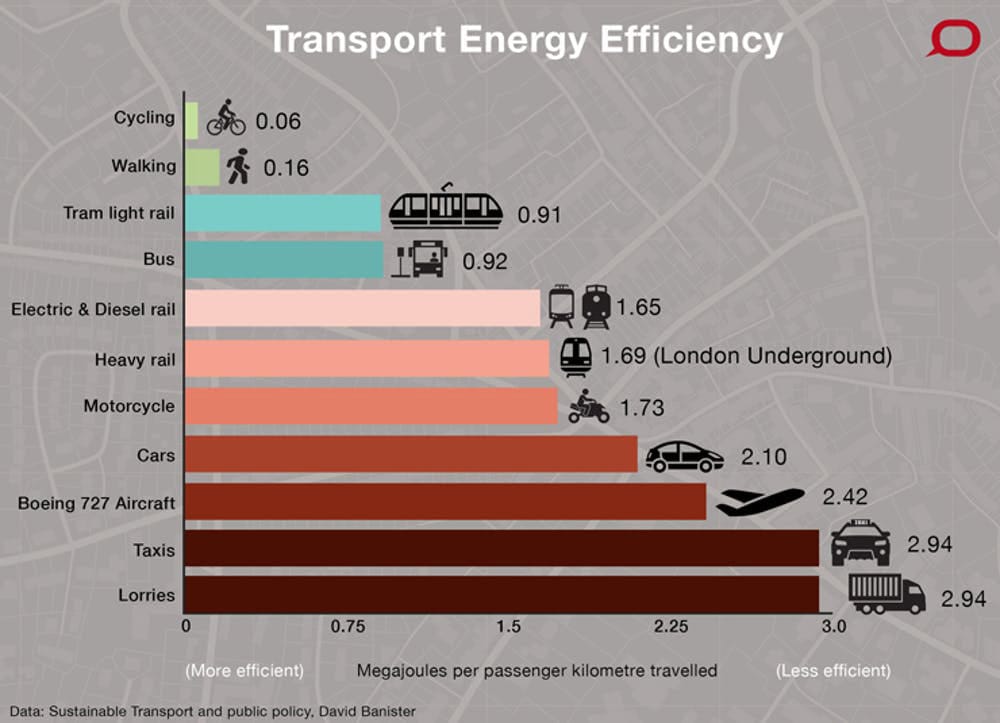
Want a quick visual representation of different transports’ emissions? This shows the average passenger for the average vehicle per passenger kilometre travelled for business travel: real emissions may be lower or higher depending on passenger numbers and fuel source.

7. In destination, use other methods of transportation
-
Walking and cycling:
Not only the most environmentally friendly A to B method of travel saving carbon emissions, but person-power is better for your health too.
-
In 2014, transport sustainability researcher David Banister calculated the relative amounts of energy that different modes of transport consume, adjusted for carrying capacity (the Conversation):
-
After walking and cycling, tram light rail came ahead of the bus, beating heavy rail, electric rail and diesel:
But remember there’s more to responsible tourism than emissions:
Animals used in transport, such as elephants or even horses, are often exploited and mistreated to be trained and managed for tourists’ benefit.
8. Stay in low carbon impact accommodations
There are many considerations for lowering impact in accommodation:
-
Energy source: fossil fuel or renewable.
-
Energy consumption: for heating, air conditioning, lighting.
-
Energy saving appliances: light bulbs, switch-offs.
-
Water heating: and hot water use, showers over baths.
-
Cooking fuel: and energy consumption.
-
Refrigeration: (preferably cool) temperature, location, use (such as cool foods first).
-
Food: production, type, location and transportation: local, organic, less meat is preferable.
Likewise, there’s more to responsible tourism accommodation than emissions:
Where your money goes, staff employment and conditions, water, infrastructure, community support for poverty, agriculture, education, health, gender equality, other inequalities, conservation, partnerships and peace.
ie. It’s complicated! This is where Earth Changers step in, to bring you the very best options in positive impact tourism. We do the hard work so you don’t have to.

9. Choose lower carbon impact eating
Buying local organic food not only supports local staff and economy and your health, but also means
-
Less imports: meaning less food miles.
-
Less processed: meaning less energy consumption.
-
A plant-based diet: means less carbon emissions from meat farming and its linked deforestation.
10. Choose net positive impact activities
Applying the points above to apply to your in-destination time, and you’ll make wiser choices for activities’ carbon impacts while you’re there. For example, choose
-
Walking / bike tours: over bus tours.
-
Local over chain: buy from local independent retailers and support the local economy.
-
Shop like a local and cook like a local.
Conclusion
Travel is continuing to grow apace, and with transportation especially flights comes greater emissions of carbon greenhouse gases, with limited options yet available for alternative energy options and successful offset relatively insignificant in comparison. Climate change is growing faster than its potential mitigation. Really radical change is required.
Flying long distances to visit wildlife in protected areas can critically save them, along with the carbon they secure and the communities whose livelihoods serve them. Whilst not immediately obvious, not only may it do good, but it might also be required for the future survival of species.
If you do lessen your carbon impact, not only do you have a more sustainable trip, but you’ll also have a more authentic, local, better, experience – which possibly wouldn’t exist otherwise.
Think of something we’ve left out? Questions? Let us know!