


Dwindling supplies of safe drinking water is a major problem impacting every continent.
The global demand for water grows on average 1% per year due to population growth, economic development, changing consumption and global warming.
However, since the 1990s, water pollution has worsened in almost all rivers in Africa, Asia and Latin America, with deterioration of water quality expected to further escalate over the next decades. The number of people globally also exposed to flood risk today is billions, around 25% world population. (World Bank, Nature Communications, Moody’s) – with global flooding expected to increase significantly. Plus, land degradation, desertification, and drought due to water scarcity globally affects billions too. Reduced access to clean water impacts agriculture, thus food and drinking, hygiene and health, and livelihoods and income caused by these interconnected issues.
Water issues thus create the most significant ‘natural disaster’ based on mortality and socio-economic impact relative to GDP per capita.
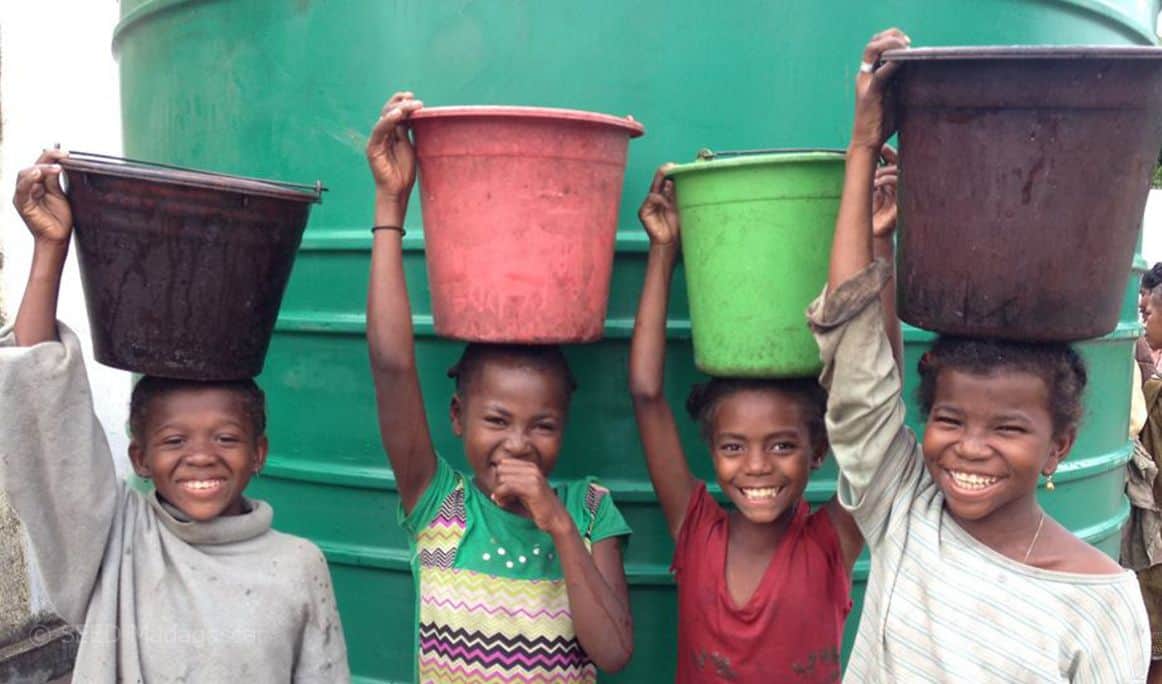
The lack of clean water for drinking and sanitation encourages disease, killing millions with preventable, contaminated water-induced diarrhoea and dehydration, or inhibiting work and study, resulting in the loss of millions of days working for livelihoods, and education, creating a vicious circle of difficult to break poverty. Some people walk miles every day to collect water.
Universal access to clean water and sanitation is thus one of 17 Global Goals that make up the 2030 Agenda for Sustainable Development:
SDG #6:
“Ensure availability and sustainable management of water and sanitation for all”
SDG 6: Clean Water & Sanitation – Progress
- 4 billion people, nearly half the current global population, face severe water scarcity for at least one month per year (Global Water Bankruptcy, 2026)
- 3.4 billion lack safely managed sanitation, including 1.7 billion without basic sanitation services (UN Stats, 2024).
- 90% natural disasters are water-related and cause the highest number of fatalities: >70% of deaths (UNDRR/UNESCO, 2015)
-
>100%: Northern Africa’s critical water stress – it withdraws more freshwater than its renewable resources provide. Central & Southern Asia: >75% high water stress – more than 3/4 of renewable freshwater is taken for agriculture, industry, and domestic use (UN).
-
83%: Population exposed to extremely high water stress in the Middle East and North Africa, the most water-stressed regions, followed by South Asia with 74% of its population exposed (World Resources Institute, 2023).
-
81%: species dependent on inland wetlands have declined since 1970 (2024 Global Wetland Outlook).
- 50%: The potential reduction of world population suffering water scarcity that could be created by limiting global warming to 1.5°C compared to 2°C (with variability between regions; IPCC, 2018).
-
25 countries are currently exposed to extremely high water stress annually – they use over 80% of their renewable water supply for irrigation, livestock, industry and domestic needs (WRI, 2023).
-
1.7 billion people lack basic handwashing facilities with soap & water at home, including 611 million with no facility at all (WHO/UNICEF, 2024)
- 1 in 4 – or 2.1 billion people globally – still lack access to safely managed drinking water, including 106 million who drink directly from untreated surface sources (WHO/UNICEF, 2025)
-
419 million people at least continue to practice open defecation (WHO/UNICEF, 2022)
-
~1000 children a day die due to preventable water and sanitation-related diarrheal diseases (WHO/UNICEF, 2023).
- 447 million children in schools lack basic drinking water and 427 million lack basic sanitation (UN Stats, 2025).
-
68% of health care facilities now have hand hygiene stations, & 65% have handwashing facilities at toilets, but only 51% have both.
- 9% of health-care facilities had no water service in 2023, while 8% had no sanitation service; 9% have neither (WHO, 2022)
-
42% of household wastewater globally is not safely treated before discharge; only 38% of industrial wastewater is treated globally, with only 27% safely treated – though available data is limited (UN Water / WHO, 2024).
-
46%: The average identified funding gap between available resources and national Water, Sanitation & Hygiene (WASH) targets. Current investments must triple (a 2x to 3x shortfall) to meet SDG 6 targets (UN-Water/WHO GLAAS, 2025)
-
6x / 5x / 3x: the pace of progress required to meet Agenda 2030 targets for drinking water / sanitation / hygiene (UN Water, 2023).
Sub-Saharan Africa is furthest behind, but to reduce pressure on freshwater resources, every country and region needs to increase water-use efficiency and the use of non-conventional water resources, eg. wastewater, desalinated water, and agricultural drainage water.
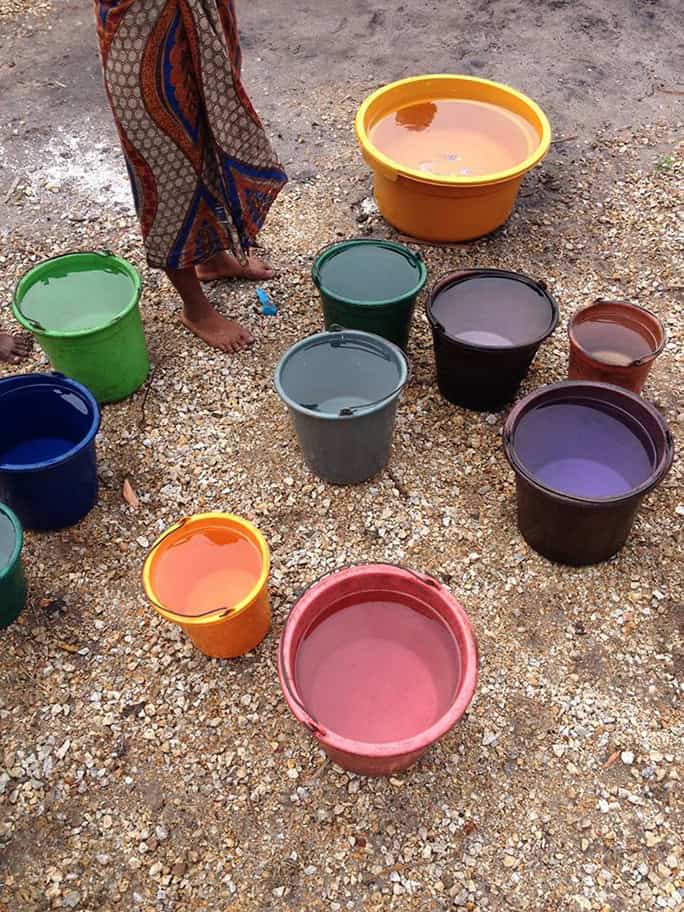
SDG6, The Global Water and Sanitation Challenge
Although tourism accounts for a small proportion of global water use (<1% (WTTC, 2023), vs agriculture 70%, UNESCO 2024), it uses significant volumes – often 84 litres (Becken, 2014) to 1500 litres (Sustainable Hospitality Alliance, 2018), with facilities like pools, irrigation, cooling, drinking, waste management, or up to 5,000 liters per day to support food requirements dependent on location (eg. islands), local provision, weather and visitation (Gössling, 2013).
A local may use only 30 litres per day, yet it can take 50 million litres of water to keep a single 18-hole golf course lush and green for a year, the same as almost a thousand average households (Tourism Concern, 2014). Whilst now greater, so is water re-use.
Where water is scarce, its tourism consumption can become nationally and regionally significant.
The right to water should not be compromised by tourism. Yet, research shows tourists consume far more water on average than they do at home, and far more than locals, further depleting often crucial water supply for local populations: 100 guests in a luxury hotel for just 55 days would support 100 families in poor countries for three years. (Tourism Concern, 2014)
Limited natural water has prevented other people and places, like Floreana Island in the Galapagos, developing their population, let alone tourism infrastructure. Tourism if developed sustainably can improve water and sanitation to a local area. So how can tourism aid in alleviating water poverty rather than contributing to it?
World Water Day. held annually on the 22nd March, intends to make us internationally aware of the importance of fresh water and its sustainable management.
How Water Access Affects Use
Ensuring universal access to safe and affordable drinking water by 2030 requires we invest in adequate infrastructure, provide sanitation facilities and encourage hygiene at every level. Protecting and restoring water-related ecosystems such as forests, mountains, wetlands and rivers is essential if we are to mitigate water scarcity: Freshwater ecosystems are natural sites for human settlement, enabling benefits such as transportation, natural purification, irrigation, flood protection and habitats for biodiversity.
However, population growth, agricultural intensification, urbanization and industrial production degrade freshwater bodies worldwide, threatening ecosystems and livelihoods. Globally, just 2.1% of land is covered by freshwater bodies: 3.5% in developed countries, 1.4% in developing countries, 1.2% in Least Developed Countries and 1% in Small Island Developing States (UN Stats): increasing vulnerability to climate change and water scarcity.
Internationally, more transboundary cooperation is needed to encourage water efficiency and support treatment technologies in developing countries and regional integration. Integrated water resources management is a global framework covering policies, institutions, management instruments and financing for the comprehensive and collaborative management of water resources.
Locally, thousands of communities rely on wells for their water supply, often under extreme demand or prolonged dry or broken periods, and rivers, often hours’ walk away and frequented by livestock.
-
Under SEED Madagascar‘s 3 year Malio project, over 11,000 additional people had access to improved household sanitation facilities, with an additional 7,406 students benefiting from latrine construction and refurbishments at their schools, delivering water, sanitation, and hygiene (WASH) educational lessons to 6,567 primary school children and knowledge sharing sessions with families.
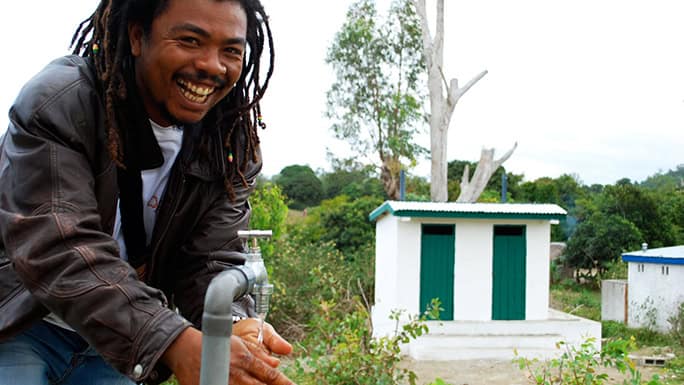
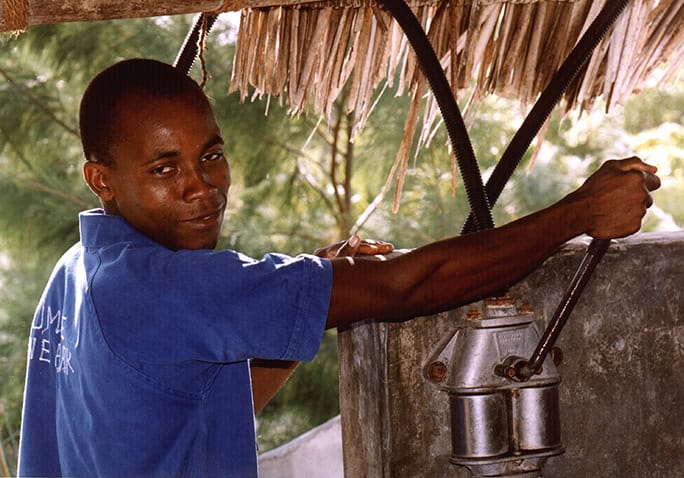
Building a well can be a fantastic first step towards a community gaining access to clean drinking water, but all too often, the focus of water-provision project is to build the infrastructure and leave, with no support for long-term maintenance and with little or no support from local government to maintain community water supplies. Infrastructure alone is not sustainable, it is vital that people have the skills to look after their water points themselves.
-
SEED Madagascar‘s Project Fatsaka aimed to improve drinking-water practices and build capacity in 28 communities to manage and maintain their wells independently, encouraging safeguarding such as constructing fences and repairs, and providing “top-up” maintenance support, training and assessments to ensure well construction work is what people really need.
-
When Tiger Mountain Pokhara Lodge was built, the village permitted the use of a spring, so the families from whom the land was bought were also provided with private water taps, with resulting health and education benefits: freeing girls’ time for school that would otherwise be demanded for fetching water. Pumping water 1000ft to the Lodge also makes water conservation valued, so all toilets have a shortened flush, most taps are fitted with aerators and flow rates of taps, showers and toilets are monitored.
Water Stress Levels
High water stress – the withdrawal of too much fresh water from natural sources compared with the fresh water available – can lead to water scarcity, have devastating consequences for the environment and can constrain or reverse sustainable development.
Global water stress can mask huge regional variations: Northern Africa and Middle East register Extremely High water stress levels more than 80%, followed by South Asia – high at more than 70%.
Increasing water-use efficiency reduces the risk of water stress, reinforcing both economic and environmental resilience; Increasing agricultural water productivity (70% of water use) is a key intervention for improving water-use efficiency.
Rain Water Harvesting
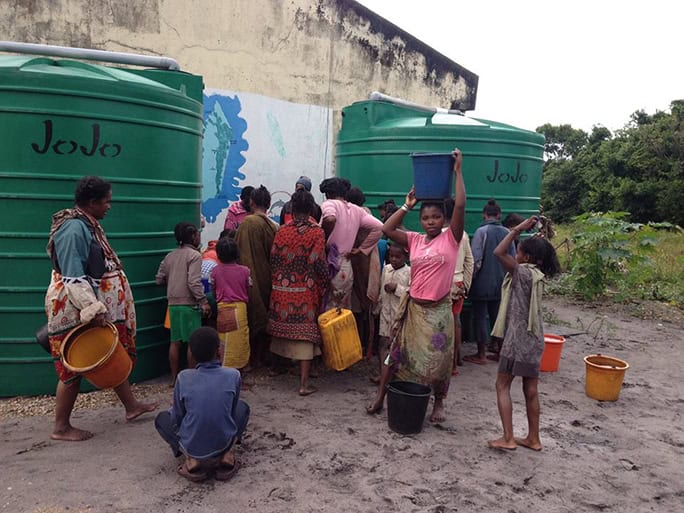
This enables communities’ simple, affordable and replicable technique of obtaining clean drinking water from rain. Schools often offer excellent locations for new pre-galvanised roofs for clean and efficient water run-off, space for large storage tanks (eg. 10,000 litres), and a simple guttering setup fitted with a downpipe first flush system to ensure water entering the tanks is clean. Smaller, plastic containers (eg. 250 litres) can make the system scale up and be easily replicable by community households, facilitating families to create their own systems to provide themselves with clean water at home.
-
SEED Madagascar is employing rain water harvesting projects to address the fundamental problem, that only ~22% of Madagascar’s population have access to safely managed water, and 51%-54% have access to at least basic water services in Madagascar, meaning approximately 14 million people lack basic clean water close to home (2026). Breakdown rates for rural water points hover near 50% in vulnerable regions due to climate shocks, hydrogeological challenges, and limited local maintenance capacity. (Serele, 2020)
-
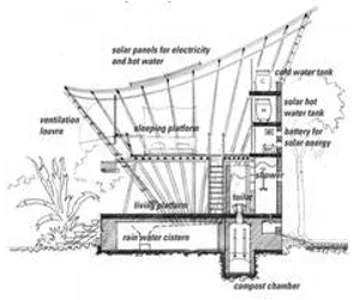
At Chumbe Island, there is no ground water source on the rocky coral island, so each bungalow collects its own freshwater supply during the rainy season. The banda bungalows are designed for optimal catchment, from the palm thatched roof via a complex filtration system to be stored in a cistern underneath. Hot & cold-water is available for the shower and hand basin, hand-pumped through a solar-powered heating system into containers. As water is too sparse, composting toilets have no-flush, zero sewage and decompose human waste quickly by reducing it to a nutrient rich dry matter to be re-used in toilets and plant beds, protecting coral reefs from run-off. Vegetative grey water from the kitchen is used to water small garden plots, thus also maximising the use of nutrients too.
Nature-Based Solutions
Currently, water management remains heavily dominated by traditional, human-built (‘grey’) infrastructure, and ecosystem degradation is a leading cause of negative impacts on hydrology, increasing water resource management challenges, with estimated 64–71% of natural wetland area worldwide lost due to human activity since 1900 (UN Water Report, 2018).
Nature-Based Solutions (NBS) are thus inspired and supported by nature, and use, or mimic, natural processes to address contemporary water management challenges, improve water security and deliver co-benefits vital to all aspects of sustainable development, particularly water for agriculture, sustainable cities and disaster risk reduction. NBS enhance water availability (e.g., soil moisture retention, groundwater recharge), improve water quality (e.g., natural and constructed wetlands), and reduce risks associated with water-related disasters and climate change (e.g., floodplain restoration, green roofs).
NBS support a circular economy that is restorative and regenerative by design and promotes greater resource productivity aiming to reduce waste and avoid pollution, including through reuse and recycling, and the concepts of green growth and the green economy, which promote sustainable natural resource use and harness natural processes to underpin economies.
NBS include green infrastructure that can substitute, augment or work in parallel with grey infrastructure in a cost-effective manner, blending green and grey to maximize benefits and system efficiency while minimizing costs and trade-offs.
Constructed Wetlands
A constructed wetland (CW) is an artificial wetland created for the purpose of treating municipal or industrial wastewater, greywater or stormwater runoff. Using natural functions of vegetation, soil, and organisms, they are designed to emulate the features of natural wetlands. Some constructed wetlands may also serve as a habitat for native and migratory wildlife, although not intended as their main purpose.
-
Tiger Mountain Pokhara Lodge in Nepal are working on installing constructed wetland (CW) reed-bed natural filtration plants.
Conservation for Water
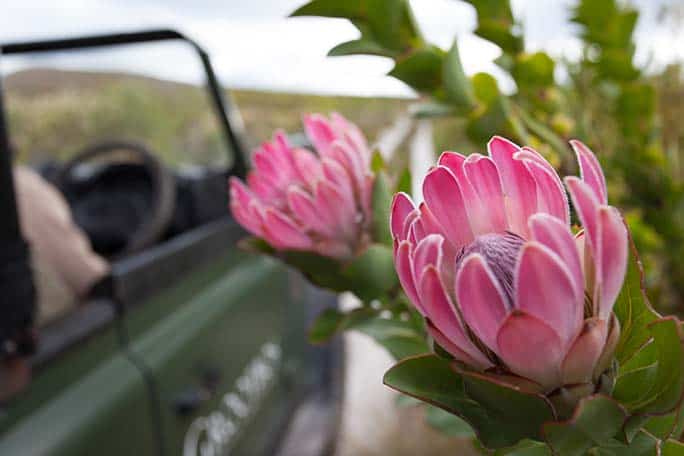
In South Africa which has suffered greatly from drought, Michael Lutzeyer knows the impact of removing non-indigenous plants for water. Alien species absorb more water than, and squeezing out, the local prized ecosystem fynbos.
“Working for Water” is a favourite phrase, employing at Grootbos marginalised local women to remove the alien species, to make space for the natural fauna, for it to survive, save water, and so lead to conservation and community support for all.
Sustainable Water Management in Tourism
Done sustainably, sustainable water management can improve a guest experience, protect the environment and biodiversity, and reduce pollution and costs.
-
To address drinking water personal consumption, many sustainable operations such as Chumbe Island and Nikoi Island desalinate and filter their own water. Providing it to guests in reusable stainless steel or glass bottles also minimises plastic waste.
-
You might like to also take with you your own personal water filtration system – our partnership with Water2Go means a 15% discount on water filter bottles that eliminate well in excess of 99.9% of all microbiological contaminants.
-
Our ocean tours partner’s exploration boat even has on-board fresh-water making.
-
At Jicaro Island Ecolodge, they don’t just provide water filtration for guests, but also for the 600-strong community who were at risk of ill health by drinking from Lake Nicaragua.
-
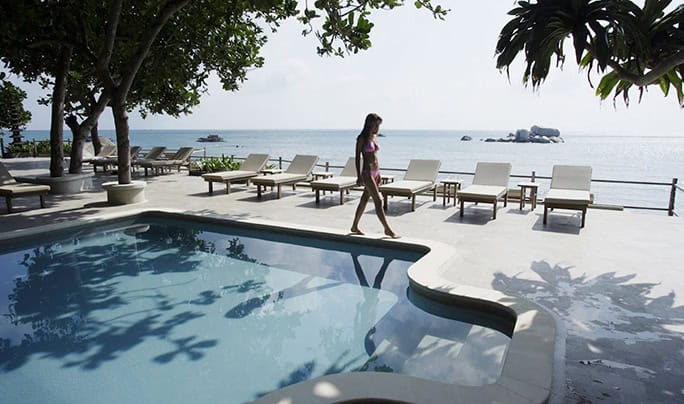
At Nikoi Island, the swimming pool uses the sea salt water, topped up by reject desalinated water used for the hospitality.
-
At Campi ya Kanzi, the camp is completely self-sufficient with water from rain, including the Kanzi House swimming pool, which would also act as a reservoir for anti-fire if required.
Water & The Guest Experience
Water can also be incredibly important to the tourist experience through water-based activities and connection to nature, for example out on the water whale watching or kayaking the mangroves at Lapa Rios, Stand Up Paddleboarding on Lake Nicaragua at Jicaro Island Ecolodge, snorkelling at Chumbe Island Coral Park where marine conservation is also key to the guest experience.
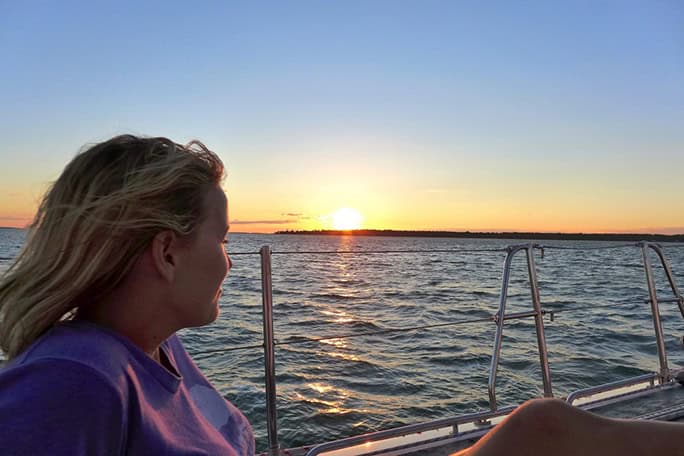
Finally, water is often at least part of the reason tourists choose a resort or destination in the first place. Sailing operations, like our ocean tours partner would not exist without it – it’s their whole raison d’etre. And where would we be without a great sunset over the water?
Links with the other Sustainable Development Goals
Goal 1 – End poverty: Lack of water results in a vicious circle of ill-health, missing work and education, hampering income & social mobility.
Goal 2 – Zero hunger: We need water to wash and cook food, and dishes. It’s practically inseparable!
Goal 3 – Health & well-being: is quite simply impossible without clean water and sanitation. Lack spreads disease.
Goal 4 – Quality education: is required for water, sanitation, and hygiene behaviour change eg. reducing open defecation, washing hands.
Goal 5 – Gender equality: Females’ time is often consumed carrying water for distance and looking after children ill due to poor sanitation.
Goal 7 – Sustainable energy: provides power to pump water for irrigation, to process crops, for clean drinking and sanitation.
Goal 8 – Employment & economic growth: May be prevented if water is not clean, and ill health prevents people working.
Goal 9 – Industry, innovation & infrastructure: Access to affordable water and sanitation requires adequate infrastructure and facilities.
Goal 10 – Reduced inequalities: Unequal access to water is a huge inequality worldwide, especially between tourism’s and locals’ facilities.
Goal 11 – Sustainable cities & communities: require access to safe and affordable water and sanitation.
Goal 12 – Sustainable consumption and production: requires clean water and sanitation for effective natural resource management.
Goal 13 – Climate change: Extreme weather can affect access, and lead to water shortages and infectious diseases.
Goal 14 – Marine conservation: unclean water pollutants can cause eutrophication and get into the food chain via fish.
Goal 15 – Life on land – all life requires clean water to survive.
Goal 16 – Peace and justice requires clean water access for a sustainable communities. Scarcity drives conflict and migration.
Goal 17 – Partnerships between local communities and tourism help develop water infrastructure for access for all.